
Case Study
Simple, not empty.
A mental wellbeing case-study

A strange picture can sometimes explain a thought better than a paragraph can.
“Not because the picture gives us an answer.
Because, for a moment, it allows us to see the thought from the outside.
That is the idea behind OneAkash.
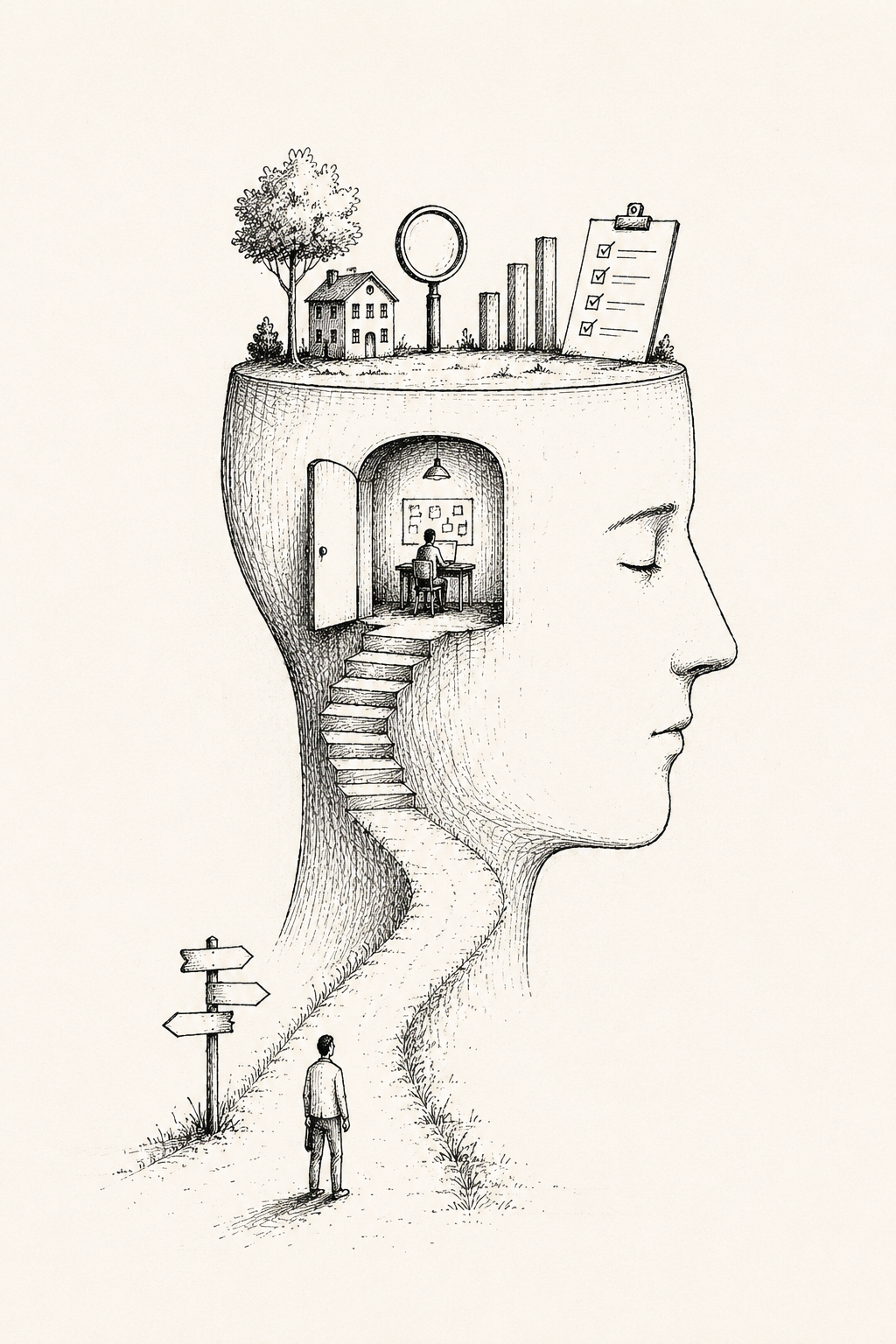
OneAkash is an ongoing experiment in using simple surreal drawings to make ordinary human thoughts and mental patterns visible.
Overthinking. Comparison. Insecurity. Perfectionism. Fear. Feeling overwhelmed. Taking things personally.
We experience these things internally, often so frequently that they become almost invisible to us.”
The problem with making something “simple”
When people talk about simplicity in visual design, it is easy to confuse simplicity with the absence of detail.
Remove things. Make it clean. Use fewer colours. Leave more empty space. Make the composition minimal. All of that can produce something that looks simple. But visual simplicity and conceptual simplicity are not the same thing.
A drawing can contain almost nothing and still say almost nothing. For OneAkash, simplicity has to work differently. The goal isn't to remove thought. It is to remove everything that doesn't serve the thought.

A useful test became:
If I remove this element, does the idea become weaker?
If the answer is no, it probably doesn't belong. That sounds like a design rule. But it became something more important. It became a way of thinking about mental experiences themselves.
My Approach:
-
I believe good design starts with understanding what happens in a person’s head before deciding what should happen on the screen.
I studied user behaviour through market research, user interviews, focus groups, competitor analysis and platform usage patterns. The goal was to uncover the motivations, needs, pain points and behaviours behind the actions.
-
The next step was turning those insights into experiences that connect what people need with what the product can actually deliver.
I focused on translating behavioural insights into clearer journeys, simpler interactions and decisions that feel natural to the user.
Copyrights with JP Morgan Chase, where I served as the lead designer for the IPB client onboarding initiative. The case study demonstrates my ability to solve complex business problems through user-centered design thinking.